

Some landscapes are defined by one main feature, but Mojanda isn't like that.
What stayed with me was that the landscape appeared in layers—first the water, then the páramo, followed by the ridges, the clouds, and finally distance—each feature becoming visible bit by bit as I moved through the highlands.
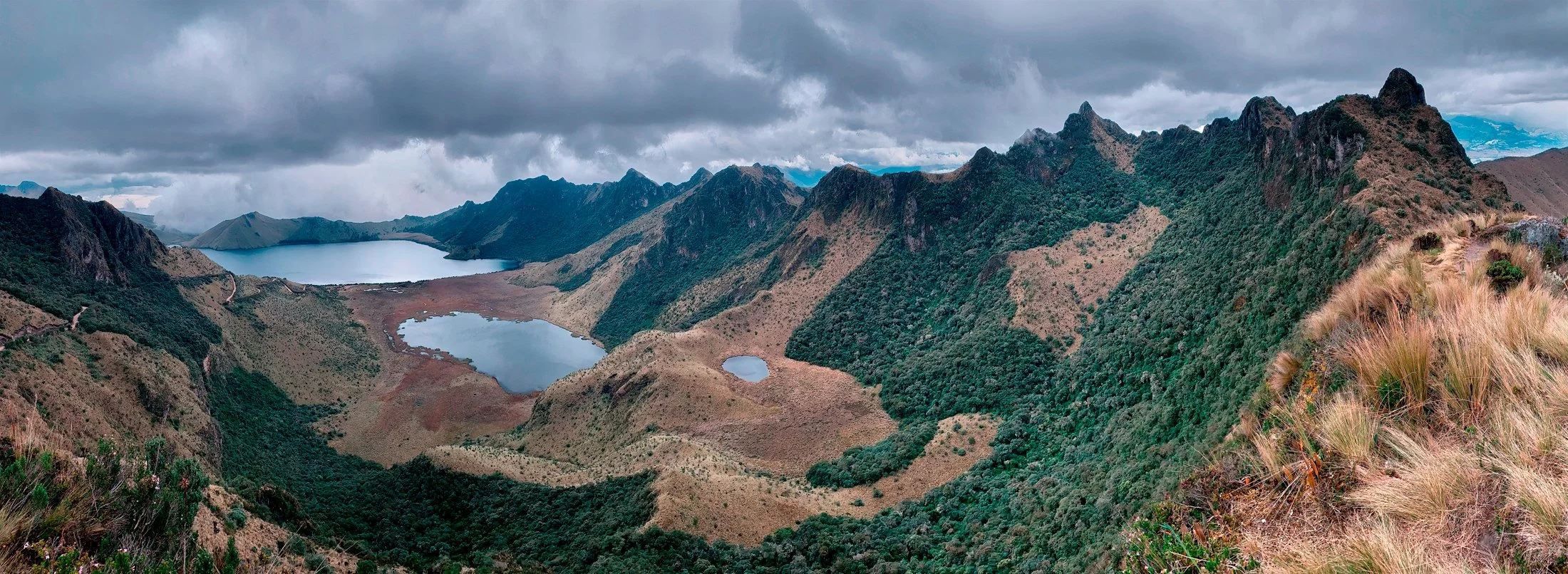
From the higher ground, the lakes looked as though they were almost hanging in the volcanic landscape. Although their surfaces were calm, the mountains around them gave the whole scene a feeling of tension and vastness. There was no sense of isolation; the water, the ridges, the vegetation, and the changing sky all seemed part of one single structure.
The lake known as Mojanda consists of three lakes: Caricocha (the largest, meaning "Male Lake"), Huarnicocha ("Female Lake"), and Yanacocha ("Black Lake"), located in a high Andean area near Otavalo and under the watch of the Fuya Fuya massif.
They sit at a chilly altitude of roughly 3,700 to 3,800 meters (12,100 to 12,500 feet) above sea level. The lakes rest inside an ancient volcanic caldera flanked by the Fuya Fuya mountain and Cerro Negro (Yanahurco).
What interested me most from a photographic point of view was not merely the presence of lakes, but the relationship between the various planes of the landscape.
The line of sight moves from the vegetation in the foreground to the water, then across the crater-shaped features, and finally to the distant ridges. The clouds finish off the scene by continually altering the atmosphere and the distribution of light.
It's a place in which photography requires patience.
The landscape is already quite complex; it becomes weaker if you add too much to the composition. The problem then is to work out which elements belong and which do not.
I searched for lines, boundaries, and transitions: where vegetation ends and rock begins, where water breaks into land, and the silhouettes of ridges against the sky.
In places such as Mojanda, it is hard to judge how large something is because, lacking roads, buildings, or people, the mountains have no familiar points of reference, and thus the landscape seems larger and more isolated than it really is.
One reason the scene drew me in was its lack of human scale. The photograph started by showing where one was and gradually became concerned with arranging the landscape through relationships—such as those between water and land, distance and proximity, stillness and movement.
Mojanda pointed out that the most powerful landscapes have no single striking feature, but rather several elements that quietly rely on one another.
The lakes form part of that balance.
So are the mountains.
The sky is as well.
